
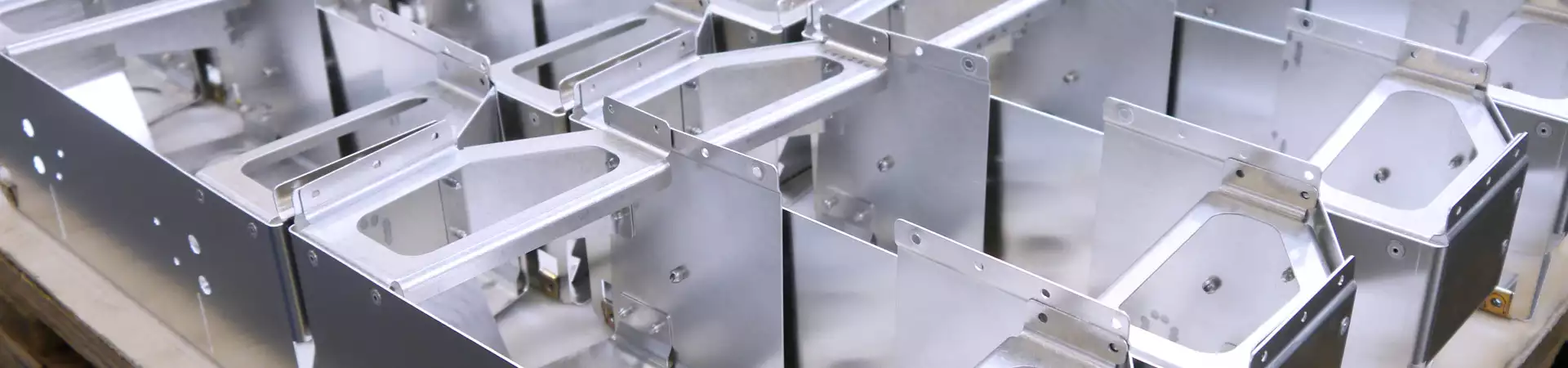
Metal-based communications technology: Enclosures and assemblies in accordance with standards
Metal enclosures and chassis components for information technology and telecommunications fulfil defined electrical, mechanical and thermal protection functions. BVS Blechtechnik manufactures enclosures to customer drawings, sub-assemblies and covers from thin sheet metal. Production is carried out in compliance with current industry standards (IEC 60297, DIN 41494) as well as electromagnetic compatibility requirements (EN 55032, IEC 61000).
Send us your drawings or 3D models. You will receive expert technical feedback and a transparent quotation within a short time.
Compliance with EMC requirements through selective masking
To ensure effective electromagnetic shielding and compliance with product-specific EMC requirements, electrically conductive connections are provided between the relevant housing components. The design is based on current technical standards and relevant EMC standards, such as EN 55032. As powder coatings are electrically insulating, BVS implements defined process steps prior to surface treatment:
- Selective masking: Earthing points, contact surfaces and shielding junctions are masked off in accordance with the drawing specifications prior to powder application.
- Electrical equipotential bonding: After the powder has been baked, bare metal surfaces remain for the protective conductor connection and the enclosure connection.
- Identical joint locations: Mechanical joining methods such as clinching, press-fit fasteners or spot welding enable reproducible connections and facilitate electrical contact between the enclosure components
Manufacturing processes for plug-in modules, housings and chassis
The manufacture of standard-compliant assemblies in the thin-sheet metal sector, up to 3.0 mm thick, follows a precisely co-ordinated process chain. During the cutting stage, recesses are laser-cut and fan hole patterns and ventilation slats are punched. The targeted addition of beading increases the inherent rigidity of thin sheets and reduces disruptive resonance vibrations from fans or drives.
During the subsequent bending process, automatic angle measurement systems fitted to the presses correct for material variations directly during the bending process, ensuring a high degree of dimensional accuracy for the inserts. The components are joined using TIG welding or robot-assisted laser welding, which, thanks to the low heat input, minimises distortion of the housing. The final stage involves mechanical assembly, comprising the insertion of press-fit connectors, the joining of chassis parts, and the fitting of mechanical seals and fittings.
Quality and tolerance control in mass production
The design and production planning departments check geometries for tool access, bending radii and tolerance chains prior to production approval.
- First-article inspection: Verification of bending dimensions and cut contours under series production conditions.
- Visual and tactile measurement techniques: The first and last parts of a production batch are measured and documented.
- Batch separation: Sheet metal from different ingots is processed separately to rule out fluctuating springback values during bending.
Send us your CAD data and specifications. Our production planning team will assess feasibility and provide you with a transparent quotation.
Frequently asked questions about metalworking: Communications technology
Which standards are used to manufacture 19-inch enclosures and subracks?
The relevant standards are IEC 60297 and DIN 41494 for grid dimensions and height units (HE), as well as the EMC standards EN 55032 and IEC 61000 for the electromagnetic shielding of IT equipment.
How are vibrations caused by case fans prevented?
The inherent rigidity of the case wall is increased by the targeted embossing of beads and stiffening ribs into the sheet metal. This reduces the tendency for vibrations, thereby minimising resonance noise from fans or hard drives.
Why are contact surfaces masked off before powder coating?
Powder coatings are electrically insulating. By masking off specific areas, these remain bare metal, thereby ensuring the required electrical equipotential bonding between the housing components.
Which materials are processed?
We process unalloyed and galvanised steel sheets, aluminium and stainless steel in thicknesses of up to approximately 3.0 mm.
Can 19-inch enclosures be customised?
Yes. Cut-outs, mounting points, ventilation openings, front panels and surfaces can be customised in accordance with the customer’s drawing.
Does BVS also manufacture EMC-optimised enclosures?
Yes. By using defined contact surfaces, suitable joining processes and customer-specific design specifications, enclosures can be manufactured for applications with increased electromagnetic compatibility requirements.
What batch sizes are possible?
Depending on the component geometry and the scope of production, BVS carries out prototyping and pre-series production as well as recurring series production.
About us
RECHTLICHES
In der Nähe
News
 Investing in process reliability: BVS Blechtechnik optimises filter cleaning with state-of-the-art high-pressure technology23. October 2026 - 16:45
- Metal Bending: Processes, Materials, and What Really Matters in Practice31. July 2026 - 15:47
- BVS Summer BBQ in Böblingen: Team Spirit, Networking, and Cohesion as Keys to Success21. July 2026 - 11:45


Contact