
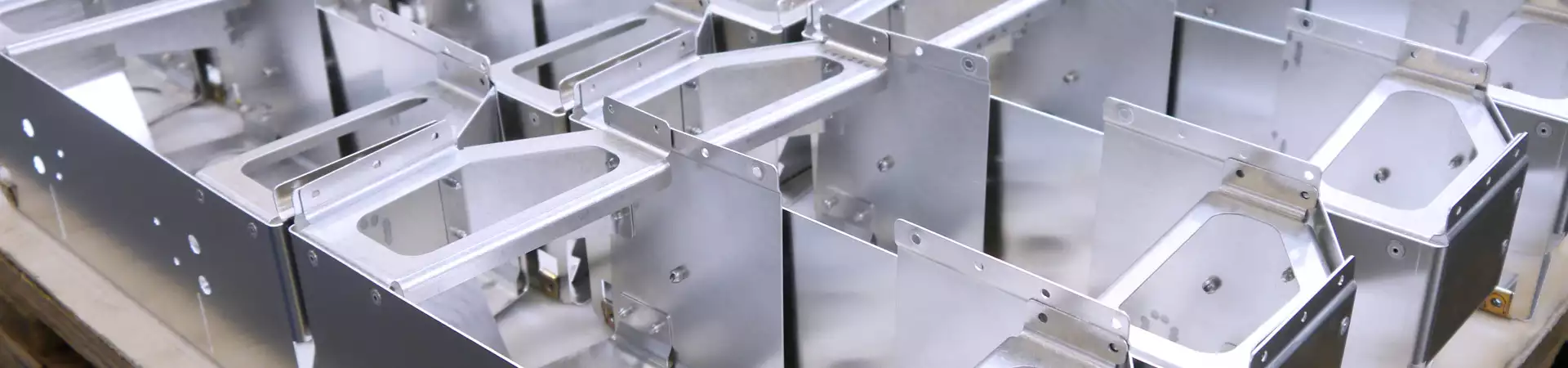
Electrical engineering sheet metal enclosures: Functionally reliable production from design to assembly
An enclosure for electrical engineering or laboratory measurement technology is a highly functional system component. It must meet precise requirements for protection classes, passive heat dissipation and electromagnetic compatibility.
EMC contacting & conductive transitions
For reliable electromagnetic shielding, we integrate defined EMC contact points along all enclosure transitions so that covers, doors and side panels ensure low-impedance, conductive connections across the entire frequency range.
EMC gaskets / Gaskets
If there are increased requirements for HF tightness, we equip the enclosures with conductive EMC gaskets or stainless steel spring strips that effectively absorb and dissipate interference radiation.
EMC for ventilation openings
If ventilation slots are to be provided despite EMC requirements, we produce honeycomb EMC grilles that maintain electromagnetic attenuation without restricting air circulation.
Cable shielding / shield connections
For shielded cables, we integrate defined shield connection points directly into the sheet metal design to ensure 360° contact between the cable shield and the housing.
BVS manufactures these enclosure systems precisely to customer specifications – from production-ready design and mechanical sheet metal processing to final assembly and testing in our own ESD area. The result is reliably manufactured components that flow directly into your value chain as a ready-to-install system without interface losses.
Check technical feasibility Let our experts check your CAD data for production efficiency, thermal requirements and cost savings.
Co-engineering: reduce series costs directly in the design phase
A large proportion of the subsequent series costs are already determined in the design phase. In practice, however, we often only receive drafts when the design is 80 to 90 percent complete. At this point, the key parameters have been determined, meaning that we can often only react during production and work with existing structures at great expense.
Genuine co-engineering at BVS starts right here – through significantly earlier involvement, ideally from the first development step. If the work preparation team is already at the table in the concept phase, we can exploit the full potential of sheet metal processing before facts are created: We replace expensive and solid milled parts with intelligent, much more cost-effective edge constructions. We incorporate targeted reinforcements and necessary fits directly into the sheet metal processing and integrate standard parts such as bushings in a reliable process. We also ensure ease of maintenance right from the start by relying on detachable connections and planning accessibility into the design.
Passive thermal management and high IP protection classes
How reliably an electronic system works depends directly on how efficiently the power loss is dissipated from the housing. This is why we consider thermal management and the required IP protection class as a design unit from the outset. We rely on tried-and-tested solutions to prevent heat build-up and ensure the longevity of the assemblies:
- Heat dissipation through aluminum: We prefer to use aluminum alloys, as this material base optimally absorbs the heat and dissipates it over a large area to the surroundings.
- Differentiating between steel and aluminum: While aluminium is ideal for passive heat dissipation due to its high thermal conductivity, we deliberately use steel enclosures for applications at risk of impact or vandalism, which we nevertheless optimize thermally through design measures.
- Importance of surface area & convection: In addition to the material, the increased surface area and specifically supported natural convection also play a key role in efficient heat dissipation.
- Contact forces & mounting types of heat sinks: Depending on the power density, we realize heat sink connections with defined contact forces or use two-component heat-conducting adhesives to ensure a permanently stable thermal transition.
- Loss-free heat sink connection: We connect special external or internal heat sinks directly to the aluminum using heat-conducting paste – for a clean thermal transition without insulating air cushions.
- Ventilation with double protection: If the concept provides for open ventilation slots for passive heat dissipation, we equip these with double protection on the inside, which acts as reliable protection against small animals.
- Protection classes to suit requirements: In the standard range, we usually design electrical engineering enclosures for IP64 (dust-tight and splash-proof). For demanding areas of application, such as laboratory measurement technology, we specifically implement significantly higher protection classes that also reliably shield the electronics from acids and aggressive media.
- Extension to IP65-IP67
For industrial or mobile applications, we regularly design enclosures with higher degrees of protection such as IP65 or IP67, including optional pressure equalization elements to prevent condensation.
Electrical conductivity, earthing and cable management
Safe equipotential bonding requires bare metal contact points. A precise masking process with special foil keeps the exact areas free of paint before powder coating and thus guarantees complete earthing ex works. Alternatively, earthing lugs or precisely fitting press-fit elements can be used directly in the sheet metal to securely screw cables later on.
If circuit boards have to be installed with strict air insulation and without housing contact, CNC-controlled press-fit technology comes into its own. This thermally neutral process creates absolutely distortion-free screw-on points for precise and fast electronics assembly. Finally, integrated slotted bridges ensure clean cable management on the inside. These are created highly efficiently in the very first work step directly on the punching machine, which significantly reduces subsequent assembly work.
Ready-to-install system components: From the surface to final assembly
The final production steps on the way from a pure sheet metal part to a functional component require precisely coordinated surface treatment and reliable assembly. Bundling these final steps under one roof eliminates error-prone interfaces and unnecessary transportation routes in the supply chain.
Durable surface protection and vandalism resistance
Enclosures in demanding outdoor areas require long-lasting corrosion protection.
Layer thicknesses + process details
We apply the CDP primer with typical layer thicknesses of 18-22 µm, while the powder coating is applied between 60 and 120 µm, depending on the color and structure.”
EMC-conductive surfaces optional
For EMC-critical applications, conductive surfaces such as electroless nickel or zinc-nickel are also available to ensure defined discharge values.
The basis for this is a high-performance duplex system: the base material is first given a cathodic dip coating and then a robust powder top coat. As soon as vandalism resistance is also required in public spaces, the sheet metal design adapts to the tougher conditions. Such specific application scenarios are directly covered by targeted measures:
- Functional coatings: Use of extremely UV-resistant powder coatings or special anti-graffiti surfaces that enable quick, residue-free removal of paint smears.
- Robust mechanics: Double-walled designs and consistently welded constructions that offer neither gaps for lever tools nor unnecessary openings to the outside.
- Integrated security: Custom-fit preparation and installation of high-security locking systems and tamper-proof fittings.
Tested ESD component assembly from a single source
Transporting empty sheet metal housings to external assemblers causes avoidable logistics costs and carries the unnecessary risk of transport damage. Our in-house, ESD-compliant component assembly seamlessly closes this gap in the supply chain. The complete assembly of the electronics and the final testing are carried out centrally at one location.
Standards reference
Our ESD assembly stations fully comply with DIN EN 61340-5-1 and therefore ensure a controlled electrostatic protected area (EPA) for all sensitive components.
Test processes
Each series undergoes documented ESD test routines, including conductive workplace measurements, regular leakage resistance tests and wristband tests for all employees on the line.
Packaging & shipping
After the final inspection, we pack the assembled modules exclusively in conductive ESD packaging or shielding containers in order to reliably protect the electronics during transportation.
Each housing and the installed system components undergo a detailed mechanical and electrical final inspection. The result is a fully tested, ready-to-install assembly that can flow into the final value chain without any interface losses.
Economical enclosure production without interface losses
A functional electrical engineering enclosure is not created by simply bending sheet metal. The actual cost-effectiveness in series production results from the intelligent combination of design, mechanical production and final assembly. When solid milled parts are replaced early on with smart bends, EMC contact points are masked directly in the powder process and the electronics are installed in the in-house ESD area, expensive reworking and error-prone logistics routes are eliminated. This closed process chain under one roof ensures a decisive time and cost advantage until the system component is ready for installation.
Discuss specific requirements for IP protection types, heat dissipation and ESD assembly directly with our production experts at eye level
FAQ: Technical details on housing production
Which protection classes (IP classes) are most frequently required for electrical enclosures?
In the standard range, the enclosures are usually designed to IP64 (dust-tight and splash-proof). In special sectors such as laboratory technology, we implement even higher protection classes at the customer’s request, for example to safely shield the technology against acids.
How is safe earthing achieved for painted sheet metal enclosures?
Contact points required for earthing are masked with a special film before powder coating to keep them free of paint. Alternatively, we insert earthing lugs or special press-fit elements that ensure direct metallic contact for the screw connection after coating.
What are press-fit elements suitable for in component assembly?
Press-fit elements serve as high-precision screw-on points. They are ideal for mounting circuit boards that need to be installed with air insulation and must not come into contact with the rest of the housing. This allows the electronics to be screwed together quickly and accurately afterwards.
How is passive heat dissipation of the electronics realized?
We prefer to use aluminum alloys because they dissipate heat optimally. Special heat sinks are connected directly to the aluminum using heat-conducting paste. If ventilation slots are provided, we fit them with a double safety device on the inside as reliable protection against small animals.
Which surface treatment protects enclosures in demanding outdoor areas?
For outdoor use, we rely on double protection: a combination of cathodic dip coating (primer) and a final powder coating on top. Depending on the requirements, we use special powders with high UV resistance or anti-graffiti properties.
About us
RECHTLICHES
In der Nähe
News


Contact