
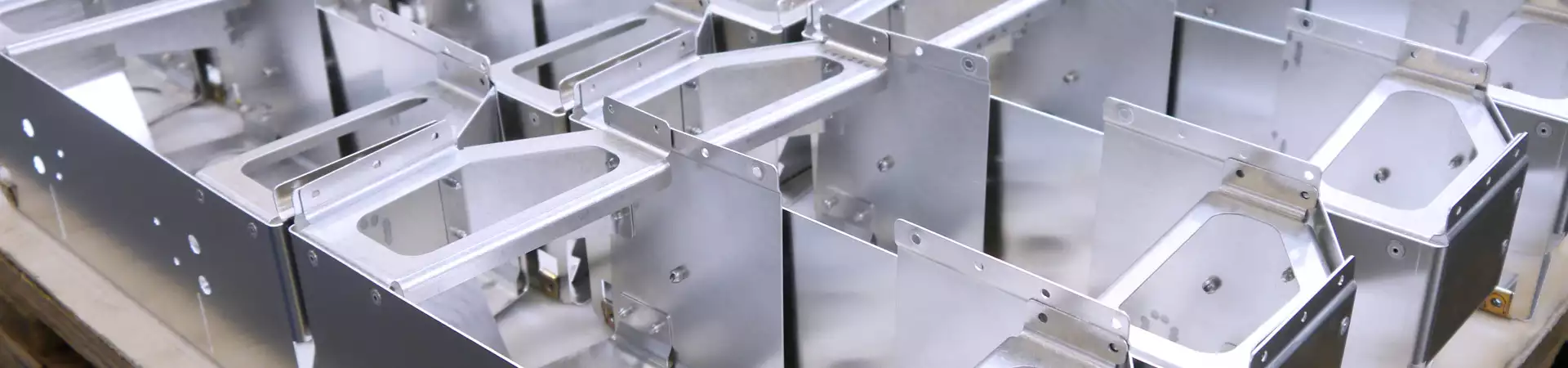
Measurement technology housing: Geometric accuracy and protection for sensitive sensors
In measurement technology, the housing is a functional component that determines the validity of the measurement results. Housings for laboratory measuring devices must protect highly sensitive electronics from electromagnetic interference fields (EMC), chemical influences, moisture and thermal stresses. BVS Blechtechnik manufactures these assemblies in a closed process chain that begins with material validation in the incoming goods department and ends with the function-tested assembly.
Have the technical feasibility of your enclosure project checked
Materials management and surface technology in the laboratory environment
The choice of material – usually aluminum or stainless steel – is determined by the physical requirements of the place of use. While aluminum supports EMC shielding attenuation due to its electrical conductivity, stainless steel offers the necessary protection against acids and aggressive cleaning agents.
Precision through material control and layer structure
- Correction of springback: Sheet metal batches vary in thickness within the standard tolerances. As the bending result depends directly on the material thickness, we measure each batch on receipt of the goods. A deviation of just 0.03 mm can change the bending angle. We store the exact measured values in the NC programs of our press brakes in order to maintain geometric accuracy without manual correction cycles.
- Cathodic dip coating against infiltration corrosion: In chemical environments, a pure powder coating often fails at sharp edges. We use cathodic dip coating (CDC). The housing is subjected to an electric current in the cathodic dip coating bath, which causes the paint to deposit electrochemically and evenly – even in deep holes and on internal edges.
- EMC integrity through masking: For an enclosure to function as a Faraday cage, the lid and body must be electrically connected. We mask contact points and earthing points precisely before painting. These bare metal contact paths prevent impedance jumps and poor earth connections, which could distort sensitive measurement signals.
Dimensional accuracy through camera alignment and gauge inspection
In the thin sheet metal sector, material stresses after punching, lasering or forming often lead to minimal distortion. As tolerances in the lower tenth range apply in metrology, we ensure quality through a two-stage validation system.
- Optical DXF comparison: The first part of a series is captured by camera and mirrored against the digital cutting file (DXF) with software support. Contour deviations or shifts in the hole pattern are detected immediately before series production starts.
- Physical acceptance gauges: We manufacture project-specific test gauges that simulate the mechanical connection points of the subsequent electronics. The assembly is only released if the housing fits into the gauge without stress.
- Distortion-free joining process: We use finely focused laser welding to keep the heat-affected zone extremely small. This prevents thermal distortion of the housing geometry and maintains dimensional accuracy when joining IP-tight components.
Co-engineering: functional integration instead of expensive milled parts
We replace complex milled parts with clever sheet metal constructions to reduce weight and costs without compromising stability.
- Press-fit technology for thread depth: Thin sheet metal does not offer enough material thickness for load-bearing cut threads. We therefore prefer to anchor press-fit bolts and nuts into the material with a force fit. This enables secure screw connections for maintenance covers or heavy components such as transformers directly in the thin sheet.
- Stiffness through forming: Through targeted beading and bending, we achieve a static stability that corresponds to solid components. Brackets for displays or circuit boards are bent directly out of the housing material, which minimizes the variety of parts and assembly errors.
Component assembly in the ESD area
The production process at BVS includes the assembly of the housing with electronic components, displays and cable harnesses on request. This step takes place in a dedicated ESD protection area in accordance with DIN EN 61340-5-1 to protect the sensors from damage caused by electrostatic discharge.
System integration is carried out consistently in accordance with your individual installation instructions and test protocols. After installation, we carry out the required protective conductor tests and functional tests so that you receive a ready-to-install unit. This shortens your internal value chain, as the assemblies can go directly to your final test or shipping department.
Arrange a project check – Let us optimize your enclosure design
FAQ:
How does BVS guarantee compliance with tight tolerances for measuring devices?
By measuring the material thickness on receipt of goods and software-supported correction of the NC programs. In addition, we validate the geometry through optical DXF comparison and measurements on the 3D measuring machine.
Why is KTL coating recommended for laboratory measuring devices?
In contrast to powder coating, CDC dip coating also provides complete protection against corrosion for internal edges and drill holes – particularly important for laboratory equipment that regularly comes into contact with acids or cleaning agents.
How does BVS solve the problem of missing thread depth in thin sheet metal?
We use press-fit technology. Force-fit anchored bolts and nuts offer high pull-out resistance for secure assembly of components where cut threads would fail.
Are the electronics installed in a protected environment?
Yes, system integration takes place in an ESD area. Assembly and electrical tests (e.g. protective conductor test) are carried out individually according to our customers’ protocols.
How is welding distortion avoided with precision housings?
Through the use of laser welding. The precise application of heat minimizes thermal distortion and maintains the dimensional accuracy of the housing geometry.
About us
RECHTLICHES
In der Nähe
News


Contact