
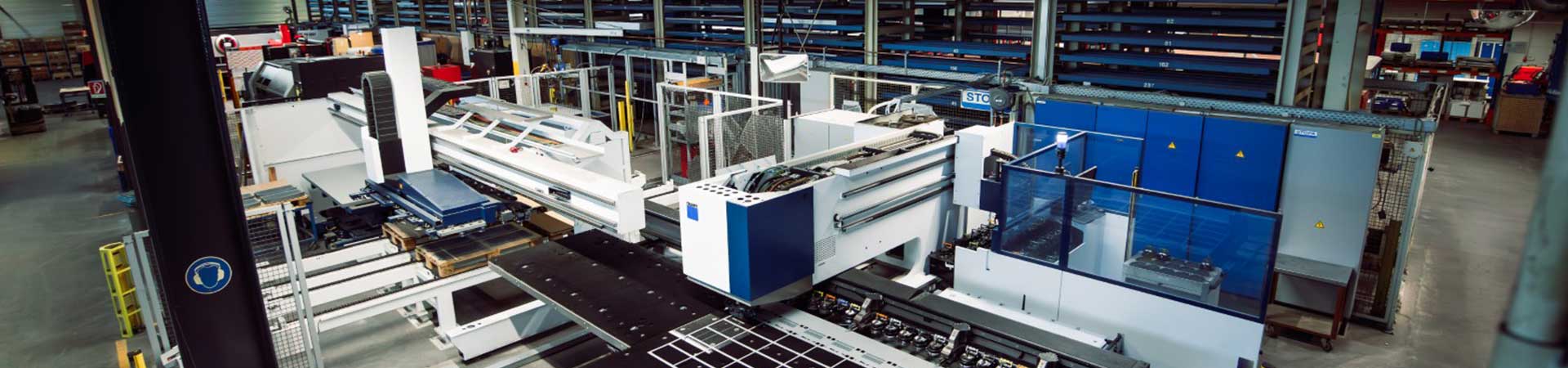
Sheet metal cutting – process, materials & quality factors at a glance
The selection of the optimum cutting process is the cornerstone for the quality and cost-effectiveness of every sheet metal part. At BVS, we rely on the standard and most frequently requested technologies – laser cutting and punching – to offer you maximum precision and flexibility in sheet metal processing.
As your specialist partner in sheet metal processing, we not only clarify the technical specifications, but also provide you with comprehensive advice on when the laser and when the punching machine is the more economical solution for your requirements. The most common cutting tasks that our customers bring to us already involve a combination of both processes.
What is sheet metal cutting? Overview of processes & areas of application
By sheet metal cutting, we mean the initial process in which the material is separated from the raw sheet precisely according to the specifications of the CAD file. These cutting processes are the first and often decisive step in the entire sheet metal processing chain. The most common cutting tasks that our customers ask us to perform involve a combination of both processes.
Material variety and thicknesses
The choice of process always starts with the material. We process the full range of materials used in sheet metal processing.
We primarily process:
- Most common materials: structural steel, stainless steel and aluminum.
- Special materials: Thanks to our fiber laser technology, we can also cut challenging materials such as copper and brass.
We work in the standard range of thin sheet processing, which means material thicknesses of 0.5 millimetres to 3 millimetres. In exceptional cases, however, thicker-walled materials up to 6 millimetres can also be cut.
Laser, water jet, plasma and punching processes in comparison
We deliberately focus on a strategic combination of the two technologically leading processes in sheet metal processing: laser cutting and punching. This dual core competence allows us to meet the entire range of customer requirements in terms of precision, speed and complexity in an optimal and cost-efficient manner.
Laser cutting
We use both CO2 lasers and fiber lasers in a complementary approach. This dual technology approach ensures that we offer the most economical and best quality solution for every type and thickness of material.
- Fiber laser technology: This modern process offers significantly higher energy efficiency (approx. 25 to 30 percent) compared to CO2 lasers (approx. 3 to 5 percent), which is directly reflected in reduced operating costs. The fiber laser also enables maximum material flexibility and the efficient processing of highly reflective metals such as copper and brass.
- CO2 laser: It is used as a supplement where its specific beam quality properties can offer advantages for certain material thicknesses and surfaces.
- Key technical data: Our available laser power is 4 kilowatts. We process the common medium format with maximum sheet formats of 2500 mm by 1250 mm. This enables us to process typical material thicknesses between 0.5 mm and 6 mm.
Punching
Punching, a so-called non-cutting separation process, is the most efficient process for medium and large-scale production and offers the greatest cost-effectiveness. This advantage is particularly clear when a large number of identical perforations or cut-outs have to be made in the sheet metal part. The extremely fast stroke frequency of the punching machine quickly amortizes the initial tool costs.
The decisive technical added value of punching compared to pure laser cutting lies in the integrated forming expertise:
- Functional elements in a single work step: We can integrate critical functional elements directly into the sheet metal during the punching process. This includes thread forming, the insertion of beads and the punching out of pull-throughs.
- Process reduction: These integrated forming processes drastically reduce the downstream joining and assembly processes, which minimizes overall production costs and lead times.
- High flexibility through tool management: Our systems allow us to retool and use specialized tools at short notice. This ensures that we can react quickly and precisely to new geometries, even with individual requirements.
Punch-laser combination
The punch-laser combination is the economically optimal solution in our production and is used most frequently. The hybrid process uses the complementary strengths of both technologies to minimize the overall processing time.
- Advantage with the degree of machining: The punching function is primarily used for all elements with a high degree of machining – i.e. the fast and cost-effective production of standard perforations, beading and thread forming. The high stroke frequency of the punching machine leads to increased productivity, which means that the acquisition costs are amortized more quickly.
- Advantage in terms of complexity and quality: The laser head takes over the production of complex, intricate outer contours, tight radii and non-standardized cut-outs. The laser delivers a high, burr-free cutting edge quality and a precision (± 0.1 mm) that cannot be achieved by punching.
- Economic optimization: By simultaneously using fast punching and precise laser technology, we can manufacture more efficiently, produce more parts and reduce set-up times. This results in a direct optimization of the cost and time balance, especially for components that have both standard features and sophisticated geometries.
Which process is optimal for your project?
Which cutting method is suitable for which material?
The choice of cutting method is closely linked to the material properties.
| Material | Laser cutting (fiber laser) | Punching | Special feature |
|---|---|---|---|
| Steel, stainless steel, aluminum | Very well suited. | Very well suited. | Laser cutting is cheaper for individual pieces. |
| Copper and brass | Yes, thanks to fiber laser technology. | Yes. | Older CO2 lasers cannot cut these materials. |
Quality factors in sheet metal cutting: Precision, cutting edge, tolerances
The quality of the cut is the fundamental basis for the entire subsequent production chain. Three central factors define the quality of a sheet metal part: the precision achieved, the quality of the cut edge and compliance with tolerances.
- Precision and dimensional accuracy
Precision describes the repeat accuracy and the absolute deviation of the manufactured component from the nominal dimension of the CAD drawing.- Tolerance definition The tolerance (± x millimetres) specifies the permissible deviation range of the actual dimension from the nominal dimension. In sheet metal cutting, compliance with tolerances is usually defined according to ISO 9013 or customer-specific, tighter specifications (e.g. ± 0.1 mm).
- Process capability: The achievable precision is directly dependent on the technology used. Thanks to their high focusability, state-of-the-art fibre lasers can produce extremely delicate contours and minimum diameters of 0.5 mm in thick material, which represents the technical limit of thin sheet metal processing.
- Repeat accuracy: Especially in series production, repeat accuracy (i.e. the precision of each individual part within a batch) is crucial. This is guaranteed by the CNC control and the thermal stability of the cutting system.
- Cut edge quality and surface roughness
The cut edge quality describes the physical condition of the cut material surface.- Roughness (Rz): The quality of the edge is technically defined by the surface roughness (Rz value). A lower roughness means a smoother cut surface, which is often required for critical components (e.g. mounting surfaces, seals).
- Influencing factors: The quality is primarily determined by the material thickness, the material type (alloy), the laser power and the selected cutting speed. Too high a speed can lead to burr formation and increased melt adhesion.
- Thermal influence: During laser cutting, a thermal influence occurs in the cut surface (heat-affected zone), which can slightly change the mechanical properties of some materials.
- Continuous quality assurance (QA) and documentation
Compliance with these quality factors must be ensured and documented using objective measurement methods in order to prove process stability.- 2D measurement: We use optical measuring systems such as the InspecVision Planar P110.25 to check critical contours and flatness, automatically comparing the first and last component of an order with the CAD data. This enables seamless monitoring of production stability across the entire batch.
- 3D measurement: For the verification of complex three-dimensional geometries, we use a 3D CNC coordinate measuring machine from Zeiss and a Keyence XM-5000 laser scanner.
- Documentation standard: Complete confirmation of standard-compliant design is provided by the initial sample test report, which documents all critical test dimensions.
Cost factors in sheet metal cutting: Material, process, geometry, number of pieces
The cost-effectiveness of sheet metal parts production results from the interplay of various interdependent factors that require an individual calculation. Material costs are often the largest single item. In order to minimize these costs, we use intelligent nesting software depending on requirements, which optimally arranges the components on the sheet metal panel and thus drastically reduces waste. In addition, the choice of cutting method directly influences the cost structure depending on the number of pieces and the geometry of the component.
The decision between laser cutting and punching is primarily determined by the following parameters:
- Laser cutting for small batches: The laser is the more cost-effective solution for small batch sizes and prototypes, as there are no tool set-up costs. The high energy efficiency of the fiber laser (approx. 25 to 30 percent) also reduces variable operating costs in the long term.
- Punching for large batches: Punching is the faster and more economical process for the production of large batch sizes. The high stroke frequency of the punching machine leads to increased productivity, which means that the acquisition costs are amortized more quickly.
- Combination for optimization: The punch-laser combination is the ideal solution for overall cost optimization, as it combines the speed of punching for standard holes with the precision of the laser for complex, burr-free outer contours. A further advantage of the combination is the possibility of adding formings and threads during the ongoing process.
Sheet metal cutting for prototypes & small series: Special features & requirements
The production of individual items, prototypes and small batches places high demands on process flexibility and the minimization of set-up costs. Our production is specifically designed to keep the throughput time (time-to-market) as short as possible.
Process selection and requirements for product development
The decision for the optimum process depends on the component geometry and the material to be processed.
- Laser cutting: This is the standard process for prototypes. As there are no fixed tool costs and the changeover is controlled digitally via CAD data, design changes can be implemented extremely quickly and cost-effectively.
- Punching: Punching is only absolutely necessary if a component requires integrated forming (e.g. beads or pull-throughs) that the laser cannot technically realize.
- Tolerance management: We also guarantee extremely tight tolerances for prototypes of components that are used as mounting plates in high-precision devices (such as in money processing), ensured by our laser and downstream 3D measurement technology.
Automation to increase efficiency
Our high level of automation is the key to keeping the cost per part low, even with small batch sizes.
- Logistical optimization: The use of automatic loading and unloading systems and our STOPA high-bay warehouse minimizes the downtimes of our machines and maximizes productive manufacturing time.
- Unmanned production: Our systems are designed for fully automated production. This enables continuous production overnight and at weekends, which optimizes machine utilization and significantly shortens throughput times.
Future orientation: AI-supported process optimization
To further increase efficiency, we are actively working on the integration of artificial intelligence (AI). The aim is to optimize cutting parameters in real time. This allows us to increase cutting speeds and reduce production costs at the same time.
CAD data & design: What customers should deliver for optimal results
Smooth production starts with data quality. We can process all common CAD data formats (e.g. DXF, DWG, STEP).
We act as a development partner and actively support you if components are not optimally designed for laser cutting. Our sound design advice helps you to make component adaptations that simplify production and thus save costs.
Typical design errors that we avoid as early as the design phase:
- Bending radii that are too tight: Radii that are too small create stresses in the material and can lead to cracks; they also require special tools.
- Bending legs that are too short: If they fall below the technologically necessary minimum dimension, the sheet metal can no longer be securely clamped and precisely formed in the press brake.
- Unnecessary complexity: Standard tools can often be used by making small adjustments to the geometry, which shortens set-up times and reduces overall costs.
Why professional manufacturing partners are important
In sheet metal processing, technical planning determines the subsequent functionality of the component. A professional manufacturing partner does not act purely as a supplier, but takes responsibility for the technical design and industrial implementation. What is relevant is the ability to evaluate material behavior, process limits and production consequences as early as the design phase and to suggest design adjustments before costs, tolerance deviations or production interruptions occur.
High demands are placed in particular on applications with dynamic component loads or complex assembly units. One example is thin sheet metal components in cash processing, where extremely tight tolerances must be adhered to due to moving units. Such specifications can only be realized if manufacturing partners have detailed experience in precision cutting technology and trace process data via certified measuring systems.
Finally checked quotations are another quality indicator. They contain all purchased parts, graduated quantity calculations and reliable delivery times. Thanks to the complete technical and commercial preliminary check, such a quotation can be transferred directly to the production process without further coordination. This reduces interface risks and shortens the lead time.
An efficient partner covers the entire process chain – from CAD data analysis and material-specific process selection to programmed cutting technology and precisely manufactured components. The combination of technological advice and reproducible production reliability leads to an economically optimized result that can be produced with predictable and reliable quality.
Frequently asked questions (FAQ)
What cutting methods are available for sheet metal?
At BVS, we primarily rely on two highly specialized processes: laser cutting and punching. We have concentrated on these standard technologies because they are the most frequently requested on the market. We do not offer processes such as waterjet cutting or plasma cutting, as the combination of our core technologies optimally covers our customers’ requirements. The most common cutting task we receive from customers is a combination of both processes.
How do I choose the right process for my material?
The choice of cutting process depends on the quantity, geometry and material properties. Laser cutting is advantageous for small batch sizes and prototypes, as there are no tool costs and complex outer contours can be precisely programmed. Punching is significantly more cost-effective for large series and a high degree of machining and enables forming processes such as threads or beading directly in the cutting process. Highly reflective materials such as copper and brass can be processed with fiber lasers.
How much does sheet metal cutting cost per meter or per part?
We cannot give a flat-rate cost per meter or per part, as it depends heavily on the complexity of your component. They are influenced by the number of pieces, the choice of material and, above all, the degree of machining (the number of cuts and holes). However, by using modern fiber lasers, which achieve an energy efficiency of around 25 to 30 percent compared to older CO2 lasers (3 to 5 percent), we can reduce the overall costs for you as a customer, as operation becomes cheaper. Smaller quantities without larger perforations are generally cheaper with the laser.
How precise are modern laser cutting systems?
Our modern laser cutting systems guarantee high precision. We can guarantee a tolerance of ±0.1 millimeters. Fiber laser technology enables us to create extremely intricate contours and even the smallest holes in thicker materials. One example of this is the realization of a 0.5 millimetre hole in 8 millimetre thick aluminium.
What CAD data is required for sheet metal cutting?
We can process all common 3D files. For an initial inquiry and fast processing, we need the details of the material, the thickness, the desired quantity and the required tolerances from you. We also offer active design advice if your components are not yet optimally designed for laser cutting.
About us
RECHTLICHES
News


Contact