
Customized control cabinet – individual solutions for every application
Are you looking for a solution that goes beyond standard enclosures because your product has special requirements in terms of design, dimensions or environmental influences? We are your high-performance development partner for customized enclosures.
Whether one-off production or sophisticated series production: at BVS Blechtechnik, we combine high-precision sheet metal processing with sound design expertise to create control cabinets that fit perfectly into your machine or system. We support you from the initial idea to the ready-to-install assembly.
What does "made-to-measure enclosure" mean?
A customized control cabinet – the special control cabinet – differs fundamentally from a modified standard control cabinet. Standard solutions can often be compared to the manufacture of white goods (such as washing machines), as they are based on standard formats that can be produced quickly.
A genuine special control cabinet, on the other hand, is always a completely new development. The main reason for a deviation from the standard dimensions usually lies in two decisive criteria:
- Dimensions and space requirements: The control cabinet must fit exactly into the installation space provided by the designer and cannot stand free-standing next to it. In today’s production plants, devices often have to be smaller and more compact, which makes it necessary to deviate from the standard dimensions.
- Design and appearance: Customers want a special design (e.g. rounded edges) or a visual unit that corresponds to the corporate design and do not want an “off-the-shelf” enclosure.
If you need an enclosure that deviates from the standard dimensions, we take care of the entire development.
Areas of application: For which industries are custom-made control cabinets suitable?
Custom-made enclosures are relevant wherever standard solutions reach their physical, functional or aesthetic limits.
The typical industries and use cases are
- Special machine construction and plant engineering: Need for millimeter-precise integration to comply with specific interface dimensions and the overall design of the machine. This requires an optimization of the packing density of the components and a reduction of the cable lengths in the field.
- Electrical engineering and automation technology: Customized enclosures with pre-assembled mounting plates and specific cut-outs significantly reduce wiring and assembly times.
- Specialized environments (medical, food, pharmaceutical): In this area, compliance with hygiene design guidelines (e.g. EHEDG) is essential. This requires smooth surfaces free of gaps and dead space, sloping roof surfaces and the use of stainless steel 1.4404 (V4A) or higher quality alloys. The aim is to avoid contamination and ensure cleanability and sterilizability.
- Shipbuilding and offshore applications: Corrosion resistance to salt water, spray mist and chemicals is a critical safety requirement. The choice of special materials (e.g. V4A/AISI 316L) is mandatory. In addition, the control cabinets must be designed to be vibration-resistant and often certified according to maritime classification societies (e.g. DNV GL).
Advantages of customized enclosures compared to standard solutions
Opting for a custom-made product is a conscious choice that should meet the requirements of your end product.
The decisive advantages of a custom-built control cabinet are:
- Optimum use of space and compactness: A custom-built control cabinet utilizes the available space to the millimetre.
- Fulfillment of extreme environmental requirements: The individual design can be adjusted to specific requirements such as optimized cooling, extreme tightness (outdoor use) or special environmental influences.
- Material-specific functionality: A stainless steel housing is required for the food industry or medical technology. Stainless steel is easy and particularly hygienic to clean, even with high-pressure cleaners.
Materials & designs: Steel, stainless steel, aluminum and special materials
The choice of material depends largely on the intended use and customer requirements and has a massive impact on the overall costs.
We use the following materials:
- Sheet steel (powder-coated): The basic solution that is sufficient for many indoor applications.
- Stainless steel (e.g. AISI 316L/V4A): Indispensable in industries with the highest hygiene requirements (food, medical technology). For offshore applications and shipbuilding, V4A is used for corrosion resistance against salt water/spray.
- Aluminum: This plays a minor role in classic enclosure construction, but is relevant when it comes to low weight or mobile requirements.
Design & development: From CAD model to design freeze
As an active development partner, we take responsibility for the design of your custom-made control cabinet. The process starts with an inquiry by email or telephone, as the complexity does not allow for an online configurator, and is secured by an NDA to protect sensitive information if required.
Our aim is to integrate the control cabinet perfectly into the specified installation space. You provide us with the dimensional specifications and component lists (ideally as CAD data). For absolute dimensional accuracy, however, the physical provision of the critical hardware – power supply units, switches, etc. – is absolutely essential, as experience has shown that manufacturers’ technical drawings often deviate from the actual dimensions.
Our close collaboration culminates in the design freeze, which defines the final specification and approves the production sample. Although we can act very flexibly during the design phase, change requests must be made before the design freeze. Subsequent adjustments are only possible with considerable additional effort and therefore additional costs.
Precise manufacturing: Bending, laser welding & surface finishing
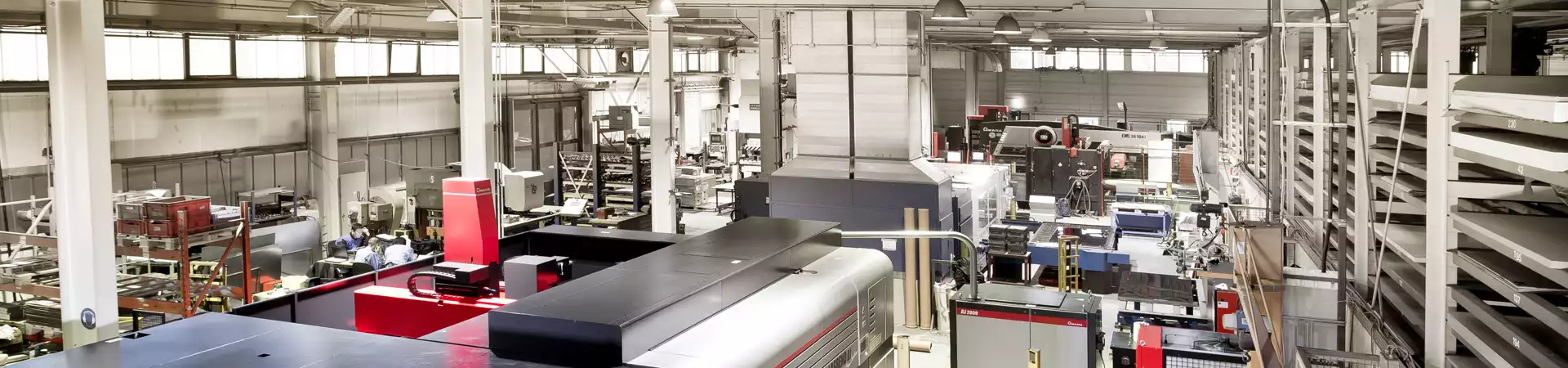
Your custom-made control cabinet goes through the entire range of sheet metal processing at our company: from blank production to bending, welding and coating to assembly.
To ensure millimeter accuracy and tightness, we rely on:
- Precision technologies: Precise automated bending machines and laser welding ensure dimensional accuracy and impermeability to environmental influences.
- In-house quality assurance: A worker self-check is carried out throughout the entire process. Our trained employees sign the production logs with their name. If required, we are happy to create a complete measurement report.
- Surface finishing: powder coating and screen printing are possible in-house. Chemical processes such as galvanizing and KTL coating (cathodic dip coating) for corrosion protection are carried out by partners.
Protection classes & requirements: IP protection, environmental influences & hygiene requirements
We can realize almost all common IP protection classes, including IP54, IP66 and IP69K, when building our custom-made enclosures.
Special requirements that necessitate a custom-made product are:
- Cleaning and hygiene: When manufacturing for medical products or the food industry, the housing must be robust enough to withstand cleaning with a high-pressure cleaner.
- Certifications for markets: We can meet the requirements of UL certification (for the US market), which stipulates traceability of the specified components and materials used and compliance with specific standards for cable insulation.
Project sequence: How your custom-made control cabinet is created step by step
The path to your individual control cabinet is a transparent process that is supported by digitalization:
- Initial inquiry & requirements analysis: You send us your requirements (dimensions, component lists) by e-mail or telephone.
- Development & optimization: We develop the complete solution, design the control cabinet according to your specifications and deliver production-ready design proposals to reduce production costs, for example through clever connection technologies.
- Design freeze & sample production: After coordination, the design freeze and production of a production sample takes place.
- Final offer: Our offer is a final offer. It is created in such a way that all purchased parts, delivery times and graduated prices have been checked beforehand. The quotation can be released directly for production.
- Production throughput: Using CAD and ERP programs, including production planning and control, we know at all times what stage of production your product is in and can provide you with information.
The development and production of special control cabinets takes around 8 weeks on average.
Costs & efficiency for custom-made enclosures
Customized products are always more expensive than standard products, as the design and development costs have to be allocated to smaller quantities. It is a conscious decision on the part of the customer to accept these costs in order to meet the requirements of their end product.
We help you to optimize overall costs by:
- Designing for production: We use our know-how to reduce production costs through intelligent designs.
- offer scaling possibilities: Higher quantities (series) mean that construction costs can be better allocated, resulting in lower prices.
Prototypes & small series production – flexible & on schedule
- Realistic delivery times: The development of a special control cabinet takes around 8 to 12 weeks on average. The pure production time for small series is around 6 weeks on average.
- Adherence to deadlines: This is ensured by software-supported production planning and control.
Why BVS? – Your advantages with an experienced development partner
We don’t just act as a supplier, but as your full-service development partner and these aspects set us apart from the competition:
- Everything from a single source: We offer you the complete range of sheet metal processing – from the blank, bending and welding to the assembly and mounting of the control cabinet.
- In-depth engineering expertise: We can design the control cabinet completely into the installation space of your machine and develop complete solutions.
- Reliability of the quotation: Our quotations are final and can be transferred directly to production, as all preliminary calculations and purchased parts have been checked.
One successful reference project was a pair of control cabinets for a customer in the special machine construction sector, in which the control cabinets were flanged to the left and right of the machine, formed a visual unit and even won a design award.
Do you need a control cabinet that does not adhere to standards, but adapts perfectly to your requirements? We look forward to hearing from you and your project!
About us
RECHTLICHES
News


Contact