
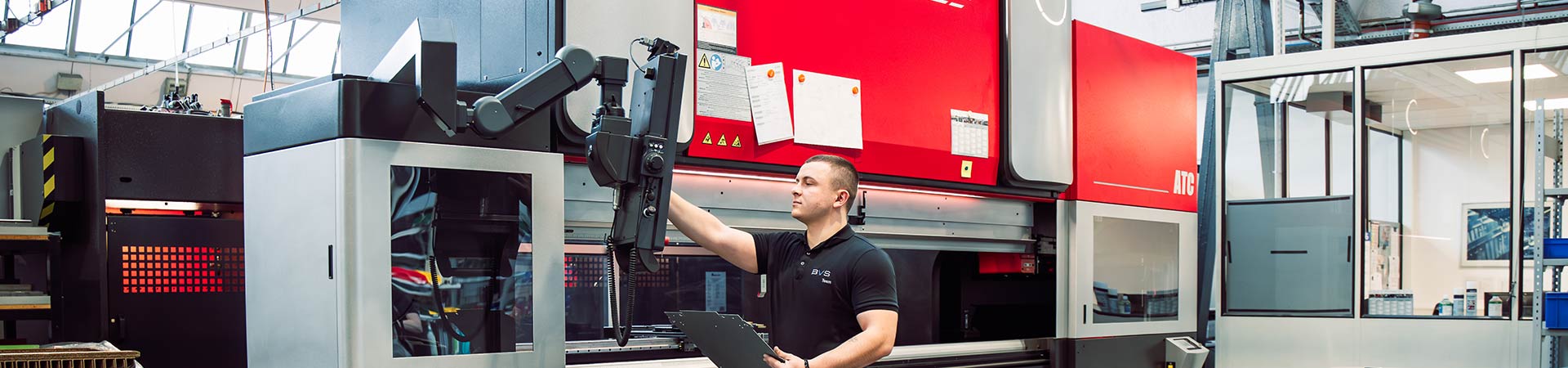
Sheet metal bending – precise bends for prototypes & small series
Demanding bends, small quantities, tight tolerances – when it comes to sheet metal bending, technical expertise is the key to the success or failure of your project. At BVS Blechtechnik, we also produce complex bent parts with the highest precision: from simple angles to 180-degree folds, short legs and Z-bends.
Whether prototypes, small batches or individual parts: Our CNC-controlled press brakes enable flexible production without minimum quantities. Springback is automatically compensated – this prevents reworking. A protective film coating ensures flawless surfaces without tool marks.
Your advantages:
- Production from quantity 1
- Economical even for prototypes & small series
- Automatic springback compensation for exact angles
- Visible surfaces without marks thanks to protective film
- Technical advice as early as the quotation phase
Sheet metal bending: Processes and possibilities
Sheet metal bending comprises various processes that are used depending on the component geometry, material and requirements. The choice of the right process has a decisive influence on quality, cost-effectiveness and feasibility. At BVS, we use all common bending processes and can advise you on the optimum solution for your project.
- Embossing bending: The sheet metal is pressed precisely into the die with high pressing force. Advantage: maximum repeat accuracy, very low springback – ideal for complex geometries and higher quantities.
- Free bending: The sheet metal is flexibly bent to the desired angle without component-specific tools. Ideal for prototypes and small series, springback is compensated for by CNC control.
- Swivel bending: Suitable for long bending edges and large components, enables multiple precise bends without reclamping. CNC controls ensure exact angles and consistent quality.
Choice of materials and thicknesses for precise bends
The choice of sheet thickness and material largely determines the feasibility and quality of the edging. At BVS, we process a wide range of materials and sheet thicknesses and advise you on the optimum combination for your component.
Standard range: 0.5 to 3 mm
Our standard range for sheet thicknesses is between 0.5 and 3 mm and covers most technical applications economically and precisely. Thinner sheets must be processed particularly gently, while thicker sheets require higher pressing forces and adapted tools. On request, we can also process special thicknesses outside the standard range.
Suitable materials for bending
Steel, stainless steel and aluminum are the most common materials for sheet metal bending. Steel offers high strength at an economical cost, stainless steel impresses with its corrosion resistance and stability, while aluminum is easy to form.
Material-specific features
Each material behaves differently when bent. Aluminum is comparatively easy to form, but reacts more sensitively to surface damage, stainless steel tends to work harden and coated sheet metal requires special surface protection. Our CNC systems automatically take these material specifics into account via stored databases and guarantee precise results regardless of the material.
Precise solutions for demanding bent parts
Not every fold is standard. Short legs, tight radii or 180-degree folds place special demands on the machine, tool and process. At BVS, we have the technical capabilities and expertise to reliably manufacture even the most demanding bent parts.
Short and narrow bending legs
Short bending legs are created with a small distance between the bending edge and the edge of the component and require special tools and precise settings. Narrow bending legs on narrow sheet metal strips are also technically challenging, as tool access and material behavior are limited. We check the feasibility as early as the quotation phase and recommend design adjustments if necessary.
High bends and Z-bends
High bends require long, precisely right-angled legs where deviations are immediately visible. Z-bends combine several bends at close intervals and place high demands on process control and collision avoidance. Our CNC press brakes enable the precise implementation of such complex geometries.
180-degree bends (folding)
When folding, the sheet is completely folded over so that two layers of material lie parallel. This increases edge stability and ensures clean, secure edges. The process is used to reinforce edges or join sheet metal parts and requires precise force control. Precise springback compensation is crucial for parallel aligned surfaces.
Heel bending and step edging
Step bending creates offset bending planes with a defined height offset, often for housings or covers. Step bends require exact tool positioning and precise angular accuracy. Typical tolerances here are ±0.2-0.4 mm.
Surface protection for flawless bent parts
Visible surfaces on bent parts must be free from scratches, pressure marks and abrasion. In order to achieve flawless results even with high surface requirements, we at BVS use targeted protective measures.
We use a coordinated system for surface protection:
- Protective films as a separating layer
- Adapted tool radii
- Gentle handling processes
- Scratch-free storage and transport containers
We also use adapted tool geometries and ensure gentle handling with suitable storage and transportation.
The required surface quality is already incorporated into the process design. Technical components without visible surfaces allow for greater tolerances, while design elements and cladding require the utmost care. Through coordinated processes and continuous testing, we ensure that visible surfaces remain protected throughout production and can be corrected at an early stage.
Angular accuracy due to automatic springback correction
Springback is a physical property in sheet metal bending in which the material elastically resets after the bending process and the angle opens slightly. Without compensation, the component would not achieve the required angle. CNC controls usually work with an angle measuring system (LVDT / laser measurement) OR database-supported compensation. Material, sheet thickness, bending radius and geometry are included in the calculation so that the bending angle is corrected during the process.
Automatic springback compensation is based on stored material-specific databases that are adapted for your component during the industrialization process.
The CNC control takes this into account automatically:
- Material
- Sheet thickness
- Bending radius
- Geometry
- Stamp shape
- Empirical values from test parts
For new material combinations or special geometries, we verify the parameters using sample parts. The result is precisely angled components with high repeat accuracy – without manual reworking.
Our press brakes automatically compensate for springback depending on the material – an advantage over many smaller bending companies that have to make manual adjustments.
Sample parts: Minimize risk, ensure quality
Sample parts are prototypes that are produced before series production and are used for functional testing, accuracy of fit checks and process validation. At BVS, we recommend sample parts in most cases, as they save time and money and prevent production errors. They allow geometry, function and surface quality to be tested before the start of series production and reveal potential problems at an early stage – especially in the case of complex assemblies, challenging bends or new materials.
Particularly in the case of new designs, sample parts prevent design or manufacturing errors from being detected in series production. Adjustments can thus be implemented before the cost-intensive series production. Sample parts also ensure the desired result when existing components are revised, as even small changes can have an impact on bending behavior, accuracy of fit or surface finish. In many projects, we take on the sampling ourselves and accompany you from the first prototype through to series production.
What we need for your request
For a precise feasibility check and a meaningful quotation, we need technical documentation for your bent part. The more complete your information, the faster we can assess feasibility, costs and delivery times.
- Technical drawings and 3D models: Fully dimensioned drawings with bending angles, radii, tolerances and material are ideal. Alternatively, we are also happy to work with 3D data in formats such as STEP, DXF or IGES. We complete any missing information in a joint dialog and check the data for production-compatible design.
- Surface requirements: Information on visible surfaces, permissible tool marks and existing coatings or paintwork are important as they influence process design and protective measures.
- Sample parts as a reference: Existing components can serve as a template. We measure the sample part, create the technical documentation and manufacture reproducible components – also using reverse engineering.
From the inquiry to the finished edging
The path to your precisely bent component is structured and transparent. We accompany you from the initial inquiry through to delivery and keep you informed of all project steps on request. After receiving your documents, our experts check the technical feasibility and evaluate the geometry, choice of material, bending process and surface requirements. We clarify any open questions directly with you and, if necessary, suggest production-related adjustments to improve quality or reduce costs. On this basis, we prepare a detailed quotation with prices, delivery times and key technical data.
For complex components or new designs, we produce sample parts on request to test the accuracy of fit, function and surface quality. This allows us to minimize risks and make adjustments before the start of series production. After your approval, the transition to series production takes place with optimized process parameters.
We continuously monitor all relevant processes during series production. Measurements during production ensure compliance with angles, dimensions and surface quality. After the final quality control, we deliver your bent parts on time – including all agreed test reports and documentation.
Frequently asked questions about sheet metal bending
Are there minimum quantities for bending sheet metal parts?
No, we manufacture bent parts from a quantity of 1. Thanks to CNC press brakes and low set-up costs, individual parts can also be produced economically.
What is the minimum length of a bending leg?
The minimum length depends on the material, sheet thickness and bending angle. As a rule of thumb: 2-3 × material thickness (depending on the tool radius). Shorter legs are also possible with special tools. With a sheet thickness of 1 mm, approx. 3-4 mm are possible; shorter legs require special tools.
What happens if my bent part does not fit after bending?
Sample parts and tests ensure a perfect fit. If deviations nevertheless occur, we analyze the cause and correct them at an early stage. We process complaints in a solution-oriented manner.
How is springback taken into account with different materials?
The springback is automatically compensated for by CNC control based on material-specific data. This results in precise angles regardless of the material.
When are sample parts useful for sheet metal bending?
Sample parts are useful for all new designs. They ensure accuracy of fit and surface finish and reduce risks, especially for new designs or assemblies. The costs are low compared to faulty series.
About us
RECHTLICHES
News


Contact