
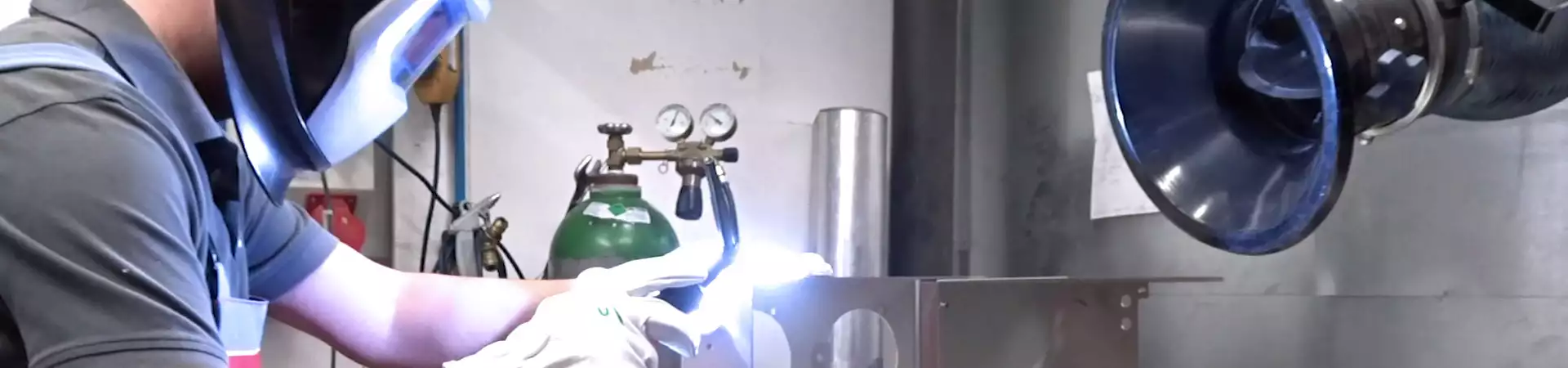
Welding robots: Efficient solutions for modern manufacturing processes
Welding robots are industrial robots that are used for the fully automated welding of components and structures. Equipped with a welding gun or torch, they produce precise and uniform weld seams. A robot arm and a powerful control unit coordinate all movements and welding parameters.
Manufacturers develop special industrial robots that are precisely tailored to the requirements of welding in terms of reach, load capacity and design. Various processes such as MIG/MAG, TIG or laser welding are used in industrial production. The choice of process depends on the material, component geometry and quality requirements. Modern processes such as CMT, PMC or LSC further increase efficiency and cost-effectiveness – and ensure the highest quality.
Your advantages at a glance:
Efficient production even for small batch sizes
Thanks to fast programming and flexible clamping systems, we can produce economically even for batch sizes of around 10 pieces – ideal for prototypes, pre-series or varying quantities.
High precision and consistent seam quality
Our Trumpf TruArc Weld 1000 welding robots deliver repeatable welding results – supported by intelligent seam tracking, they deliver consistently high quality.
Quick conversion for different components
Thanks to modular welding robot cells and flexible fixtures, we can adapt our systems to new component geometries or welding processes in no time at all.
Maximum productivity through automation solutions
Automated processes combined with extremely simple programming reduce set-up times, optimise workflows and increase efficiency – even with fluctuating order volumes.
Safety and ergonomics for employees
The robot takes on dangerous or physically demanding welding tasks, protecting employees from heat, flying sparks and difficult working positions.
Welding robotics at BVS Blechtechnik
BVS Blechtechnik relies on two state-of-the-art welding cells with TruArc Weld 1000. These systems enable precise welding of components up to 2000 mm in length – flexibly in 1- or 2-station operation. The robots process aluminium, steel alloys and stainless steel and, thanks to gap-bridging welding, can also be used reliably for demanding connections.
The advantages of our welding robots at a glance:
- Consistent seam quality – regardless of batch size or material combination
- High productivity – short cycle times thanks to parallel processing
- Flexibility – rapid conversion to new components or series
- Cost-effectiveness – efficient even with small batch sizes
- Precision – ideal for components with high dimensional and quality requirements
Areas of application for welding robots at BVS Blechtechnik
Welding robots are used in numerous industries – from the automotive and mechanical engineering sectors to electrical engineering, medical technology and aviation, right through to renewable energies and telecommunications. They are suitable for the automated processing of aluminium, steel and stainless steel and enable consistently high-quality weld seams – regardless of the number of parts.
At BVS Blechtechnik, welding robots are primarily used for components that require longer weld seams or complex geometries. Their use is particularly economical for medium to large batch sizes, as this allows the programming and set-up effort to be optimally utilised.
Thanks to modern TruArc Weld 1000 systems and continuous investment in robotic welding technology, even smaller batch sizes can now be efficiently implemented. Improved programming methods and flexible clamping devices reduce the amount of setup work required, enabling customers to benefit from short turnaround times and consistent quality even with varying orders.
Typical applications of our welding robots:
- Series production of housings, frames and brackets
- Welded assemblies for mechanical and plant engineering
- Components for medical technology and measurement technology with high precision requirements
- Components for electrical engineering and renewable energies
- Metal construction elements with recurring weld seams
Your advantage: By using automated welding cells, you receive precisely manufactured components with consistent quality, optimised cost structures and high repeat accuracy – perfect for demanding series and assembly production.
Schweißroboter-Anbieter und eingesetzte Lösungen bei BVS
BVS Blechtechnik uses two automated welding cells with TruArc Weld 1000 – a modern welding robot solution that is specially designed for efficiency, flexibility and precision. The TruArc Weld 1000 can be programmed quickly and easily, which significantly reduces set-up times and enables economical production even for smaller batch sizes.
Thanks to its repeat accuracy and consistently high welding quality, the system is particularly suitable for components with longer weld seams and consistent requirements. The robots bridge gaps and deliver clean, even seams even with complex geometries.
The welding cells at BVS are designed to be flexible: they can operate in 1- or 2-station mode and process components up to a length of 2000 mm. Thanks to their modular design, other process steps – such as automated grinding – can be carried out in the same cells in addition to MIG/MAG welding.
Another key advantage of the TruArc Weld 1000 is its extremely simple handling and intuitive programming. Instead of complicated external preparation of processes in advance, programming is carried out directly on the system. This straightforward procedure allows you to respond quickly and flexibly to new orders. The short training period and simple operation immediately increase productivity, reduce set-up times and ensure that welding jobs can be completed faster and with consistently high quality.
Welding cells and systems at BVS – flexible for every requirement
Modern welding cells and systems consist of a welding robot, a positioner and the associated welding equipment. They are the heart of industrial welding automation and offer high flexibility, efficiency and welding quality – whether in the automotive industry, mechanical engineering or other sectors.
At BVS Blechtechnik, the welding cells are deliberately designed to be modular and flexible. A wide variety of clamping devices enable components of various shapes and sizes to be securely fixed in place – from small prototypes to medium quantities and large series.
Thanks to this flexibility, the systems can respond quickly to changing requirements. Prototypes and small series benefit from short set-up times and individual programming, while automated processes ensure maximum productivity for large series.
The TruArc Weld 1000 robots used can be easily reprogrammed and operate in both 1-station and 2-station modes. This ensures optimum utilisation of available capacity and keeps production economical even when order volumes fluctuate.
Advantages and benefits of welding robotics at BVS
The use of modern welding robots offers companies maximum efficiency, flexibility and consistent quality – regardless of the number of units produced. The automated welding cells at BVS Blechtechnik primarily use the MIG/MAG process in combination with Fronius CMT welding sources. This technology ensures lower heat input, minimises distortion in the component and enables clean, even weld seams with minimal reworking.
Note: The CMT process is an innovative arc welding process in which the wire is retracted in a controlled manner during the process. This creates a particularly stable arc with minimal heat input. It is particularly suitable for thin sheets, mixed joints and demanding applications where process reliability and quality are crucial.
Precision through sensors and monitoring
Precise sensors and monitoring systems are integrated into the welding cells, controlling the entire process in real time. This allows deviations to be detected immediately and corrected automatically. The result: consistent quality and maximum process reliability – even with complex weld seams or large series.
Automation increases efficiency
The automated welding processes enable significantly higher productivity while reducing set-up times. Thanks to flexible clamping and positioning technology, components of different sizes can be quickly clamped and processed. This makes BVS welding cells particularly attractive for large series, prototypes and, increasingly, for smaller batch sizes.
Focus on safety and health
Automated welding robots not only contribute to productivity, but also reduce the workload on staff. Dangerous tasks such as welding at high temperatures or in areas that are difficult to access are performed by robots. This protects the health of employees and reduces the risk of accidents – an important factor in modern manufacturing.
People and machines in perfect harmony
Not every component is automatically welded – and this is precisely where BVS’s strength lies. Small series, complex geometries or components with particularly short weld seams are often manufactured manually in order to optimise cost-effectiveness. The robot is particularly impressive when it comes to longer weld seams, larger quantities and when high repeat accuracy is required. BVS selects the appropriate method depending on customer requirements, batch size and component geometry.
Practical example: Antenna housing for maximum precision
A clear example of the advantage of robotic welding is the manufacture of aluminium housings for antenna technology in the field of information transmission technology.
These components require long, dense weld seams, which led to excessive distortion and costly reworking when using manual processes. By using the TruArc Weld 1000, BVS was able to significantly reduce distortion, improve the quality of the weld seams and noticeably shorten production time.
Our welding robot cells offer maximum transparency in terms of feasibility, production time and costs – for precise planning without any surprises.
Frequently asked questions about welding robots
Which welding processes can be used in a welding robot cell?
Depending on the material and requirements, various welding processes are used in a modern welding robot cell – at BVS Blechtechnik, this is primarily the MIG/MAG process in combination with the Fronius CMT process. This technology ensures low heat input, minimises distortion and delivers uniform weld seams. Other processes such as TIG or laser hybrid can also be implemented in automated systems.
What advantages do automation solutions offer for welding work?
Automation solutions in welding technology increase efficiency, reduce set-up times and ensure consistently high quality welding work – regardless of the number of parts. Sensors and monitoring systems in the robot ensure that every seam is set precisely and with repeat accuracy. This allows complex components to be manufactured economically and reliably.
For which applications is a system with a welding robot cell particularly suitable?
A system with a welding robot cell is ideal for series and assembly production, long or recurring weld seams in combination with complex component geometries. It is frequently used in the automotive and engineering industries, in metal construction and in medical technology. The machine is easy to operate and programme, enabling it to be used for prototypes, small series and large series alike.
About us
RECHTLICHES
News


Contact