
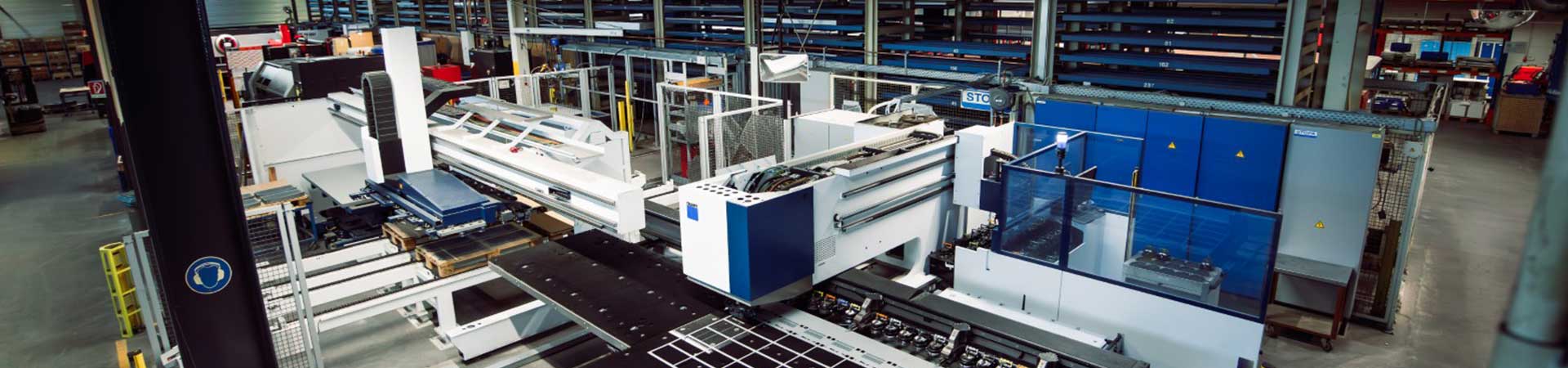
Sheet metal processing methods – your overview of cutting, bending and joining
The manufacture of sheet metal parts requires the perfect coordination of various production processes. From the raw sheet metal plate to the finished, complex component, your product goes through a chain of specialised steps.
We offer the entire value chain of thin sheet metal processing under one roof. As your full-service partner, we ensure that we use the most efficient and precise process for every challenge – from individual pieces to automated series production.
What is meant by "sheet metal processing"?
Sheet metal processing refers to the entirety of all manufacturing processes aimed at giving flat metal products – sheet metal – a specific geometric shape or adding defined functional elements to them. These processes transform the raw material into ready-to-install parts, housings or components for machines and systems. Processing typically involves little or no material removal and includes key steps such as cutting (e.g. laser cutting, punching), forming (e.g. bending) and joining (e.g. welding, soldering, riveting) the formed parts.
The result of sheet metal processing is a precise, often complex workpiece that has the necessary mechanical stability and the required accuracy of fit for further processing or final assembly.
Variety of materials: We process all common materials
All sheet metal processing begins with the selection of the right material for your project. We process the full range of materials used in sheet metal processing:
- Sheet steel
- Stainless steel
- Aluminum
- Copper
- Brass
We process material thicknesses from 0.5 mm to 3 mm, although thicker-walled materials up to 6 mm can also be processed in exceptional cases.
Cutting processes: Cutting and punching at a glance
The initial and decisive production step is the separation of the raw material from the sheet metal, which lays the geometric foundation for all subsequent forming processes. Here we rely on the established and highly efficient processes of laser cutting and punching.
Laser cutting: Maximum precision and material flexibility
Laser cutting, a thermal cutting process, enables the burr-free production of complex contours and individual geometries. It is characterized by maximum flexibility and is ideal for single pieces or small batch sizes.
- Fiber laser technology: This modern technology dominates due to its significantly higher energy efficiency and wider range of materials. It enables the precise cutting of highly reflective materials such as copper and brass, which is not possible with older CO2 lasers. The short-wave laser beam also makes it possible to produce extremely small holes with an excellent diameter-to-thickness ratio.
- CO2 laser: Used as a supplement for certain material thicknesses and specific applications where the beam quality of the CO2 laser offers advantages.
- Cut edge quality and marking: The edge quality achieved with laser-cut parts is generally very high. The need for post-processing is determined by the material specification and the required roughness of the cut surface. The process also allows direct, non-contact marking of component information using a laser.
Punching: Economical thanks to high speed
Punching is a non-cutting separation process that demonstrates its economic strengths particularly in series production and with a high degree of destruction – i.e. the need to create many uniform geometries (holes, cut-outs) in the sheet metal. The longer tool set-up time is compensated for by the extremely fast cycle time per stroke.
Punching offers numerous forming options that go beyond pure cutting:
- Functional elements: Integration of forming processes such as thread forming for threads without additional welding of nuts. Production of beads for stiffening or positioning and pull-throughs for burr-free cable routing or to create support surfaces.
- Flexibility: The use of turret punching heads and the option of adapting tools at short notice enables a flexible response to customer-specific requirements.
Punch-laser combination: synergy of both processes
Our punch-laser combination machine uses the synergy of the two technologies to achieve maximum production efficiency.
- Optimal field of application: The combination is predestined for components with a high proportion of standard perforations/forming (punching) and complex, high-precision outer contours (lasering) that require a burr-free edge.
- Economic advantage: The overall throughput is increased by speeding up the process – punching makes the fast standard perforations while the laser cuts the time-consuming, complicated contours. The unit costs are reduced compared to the laser method alone.
Forming process: Bending and folding
After the cutting process, the cut sheet metal blanks are given their third dimension through forming processes. The highest precision in this step is crucial for the accuracy of fit of the subsequent assemblies.
The required dimensional accuracy is ensured by a software-supported calculation of bending radii, bending shortening and springback in our CAD and machine programs. For large radii, we also offer round bending using 4-roll machines.
Important: Complex 3D forming such as deep drawing or embossing are not part of our range of services.
Which process suits your project?
Joining and connection techniques: welding, riveting, press-fitting
In order to produce dimensionally accurate functional assemblies from your individual parts, we use various joining processes that are optimized for the material specification and requirements.
Welding process for permanent connections
We are proficient in all relevant arc welding processes for producing resilient and tight seams in the processed materials.
- TIG (tungsten inert gas welding): Preferred for highest seam quality, lowest distortion and critical applications (e.g. thin sheets, visible seams, tightness requirements).
- MIG/MAG (metal inert/active gas welding): These processes offer high deposition rates and cost-effectiveness and are ideal for thicker material thicknesses and load-bearing structural joints.
The quality control of the weld seams is primarily carried out by visual inspection in accordance with our internal standards. For project-specific requirements, we can ensure non-destructive testing (e.g. ultrasound or dye penetrant testing) via specialized partners. We use special clamping devices for the production of complex assemblies with high demands on dimensional and angular accuracy.
Alternative joining processes
Welding is not always the best or most cost-effective solution. We therefore also offer you alternative processes that can outperform welding in certain cases:
- Stud welding: Enables the quick attachment of threaded studs without back marking or pre-drilling, which enables particularly smooth housing surfaces.
- Press-fitting: The fully automatic press-fitting of threaded bushes, studs and nuts creates a high-strength, torsion-proof connection without the need for heat. This reduces assembly time and increases repeat accuracy.
- Rivets: Used for detachable joints or in cases where the joining of dissimilar materials or cost reduction by reducing the thermal process is required.
Surface and post-processing: finishing, coating, deburring
The final treatment of the sheet metal parts ensures the specified corrosion protection, surface appearance and occupational safety. Long-lasting corrosion protection is achieved by matching the material, chemical pre-treatment and coating to the environmental class of the end product.
We carry out powder coating in-house to create a mechanically resistant, decorative surface in specific layer thicknesses. We also carry out screen printing in-house for permanent marking.
For the highest corrosion protection requirements, we use external partners for chemical processes such as electrogalvanizing and KTL coating (cathodic dip coating); KTL can be used as a highly resistant primer or sole coating.
The removal of sharp burrs and edges, which occur in particular during punching, is a standardized process step for us to ensure the cleanliness of the components and occupational safety.
The degree of edge rounding depends on the material thickness and your requirements for the feel of the workpieces. We carry out edge rounding by machine or manually.
Choosing the right procedure: criteria & application
Decisive criteria for the choice of process:
| Criterion | laser cutting | Punching | Punch-laser combination |
|---|---|---|---|
| Quantity | Less expensive for single pieces and prototypes (simple, fully automatic programming). | More economical for large series and a high degree of machining. | Ideal for small to medium series. |
| Component complexity | Ideal for complex outer contours and intricate shapes. | Ideal for quickly setting many identical holes (perforated grids) and forming. | The best compromise: High degree of cutting plus complex outer contours. |
| Additional functions | Markings possible. | Thread forming, beading, pull-throughs, clinching possible (forming). | Combines all advantages. |
| Costs & time | Faster and cheaper for small quantities, as there are no tooling costs. | Unbeatably fast with a high degree of machining in series production. | Speeds up the process for complex requirements. |
Why we are your partner for sheet metal processing
We specialize in accompanying your project from A to Z as a full-service partner.
- We cover the entire spectrum of sheet metal processing: from blank production to bending, welding, coating and assembly of the finished product.
- We continuously invest in modern systems. Current investments include the expansion of automated systems for bending and laser welding, including 5 robot-assisted bending systems (4 of which have an automatic tool changer).
- Our production processes are digital and networked. We use CAD and ERP programs for production planning and control. We are also planning an AI support project to optimize cutting parameters in order to increase cutting speeds and cut costs by reducing gas consumption.
- We ensure consistent quality through trained employees and certified processes(ISO 9001), as well as through our self-inspection.
Conclusion
Sheet metal processing is a highly complex field that requires maximum technical expertise and flexibility. By combining laser cutting, punching and automated forming processes, we are able to produce even the most complex components for demanding industries.
We attach great importance to production-oriented design and offer you a clear competitive advantage by optimizing your components to reduce costs.
Rely now on a partner in sheet metal processing that covers the entire value chain – with expertise from the sheet metal panel to the ready-to-install assembly.
Frequently asked questions (FAQ)
What sheet metal processing methods are there?
BVS offers you: Laser cutting (CO2 and fiber lasers), punching, die bending and swivel bending, round bending, MIG, MAG and TIG welding, riveting, stud welding, mechanical deburring and surface finishing.
Which materials can typically be processed in sheet metal working?
We process all common materials, including steel, stainless steel, aluminum, copper and brass.
How do quantity and batch size influence the choice of process?
Laser cutting is generally more economical for small quantities and prototypes, as there are no set-up times for punching tools. Punching is unbeatably fast for large series with a high degree of machining.
What role does surface finishing play after sheet metal processing?
Finishing, such as powder coating or KTL coating, is crucial for corrosion protection and the durability of the component, especially when used in extreme conditions or outdoors.
About us
RECHTLICHES
News


Contact