
21 years of component assembly
A Journey Through the History of the Assembly Area at
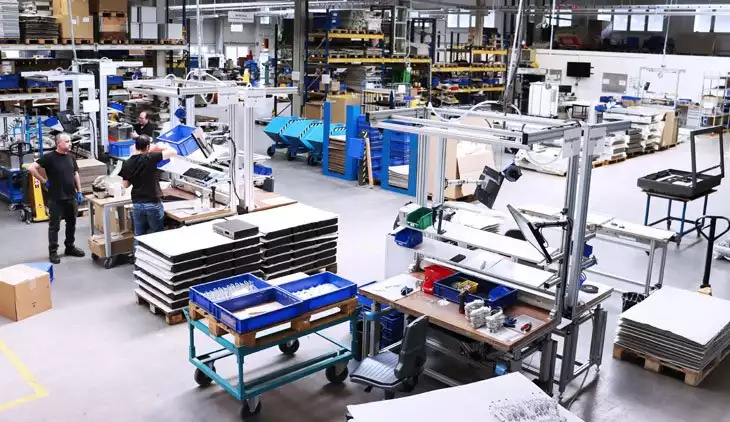
More than 21 years ago, the BVS management marked a significant milestone in the company’s history with the opening of an assembly hall. Thanks to the 1,800 m² assembly hall, the company has been able to meet the demands of many new customers in the medical technology, electrical engineering, telecommunications, and aerospace industries since the early 2000s. Join us on a “journey through time” exploring the evolution of BVS Assembly, as we look back at its origins, review successfully completed projects, and speak with long-time employees about the challenges involved in assembling subassemblies and end devices.
Assembly of components – a strategic performance component
Following the company’s relocation in 1995 from its original BVS site in Nufringen to its current plant in Böblingen, the assembly area was housed in a hall alongside other production facilities. Even then, assembly played a significant role in BVS’s service portfolio. At that time, a PC fan supplier was the company’s highest-revenue supplier, even ahead of the raw material suppliers. This clearly indicates a high production share of assemblies and enclosures – back then, the company primarily manufactured enclosures for the computer industry. Harald Steiner, Managing Director of BVS Blechtechnik, confirms: “As early as the late 1990s, we defined the goal that at least 50% of our revenue should be generated from the long-term supply of assemblies. This was – then as now – a major differentiator from our competitors. This focus has been crucial for the continuous expansion of our assembly operations over the years.”
New Assembly Hall Offers Growth Potential
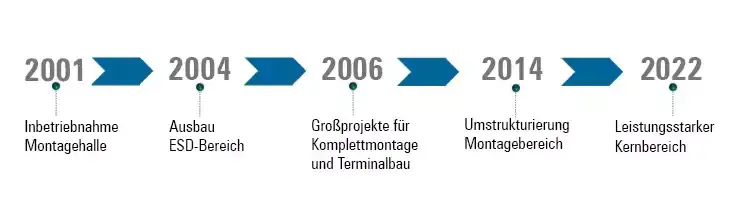
In 2001, the production facility was expanded to include a new hall, which was specifically designed to accommodate the planned expansion of assembly operations and the many new clients from the medical technology and telecommunications sectors. Initially, the assembly team took on a new project for microchip testers. These so-called test heads—a complex assembly consisting of stainless steel welded components, water distributors, and many small parts—were meticulously assembled. Additional components were manufactured using a simplified assembly line process for industrial keyboards or for customers in the dental technology sector.

Devices with electronic components securely assembled
At the same time, projects involving electronics assembly took on a larger scope. Around 2004, the BVS team expanded the assembly area to include an ESD-protected zone, which was specially designed to safeguard sensitive electronic control components using conductive tables and coated floors. In particular, products for blood analysis devices were—and still are—assembled in this protected area, incorporating numerous components, electronic parts, and cabling. Here, the BVS specialists carry out a final testing program to verify all required device functions.
Successful Large-Scale Projects, Terminal Manufacturing
In the 2000s, the variety of orders increased, as did the number of assemblies per order. These included ticket printers for the railroad and postcard vending machines. Starting in 2006, BVS technicians took on major projects for the production of end devices, such as telecommunications terminals for APC interactive solutions, which were shipped directly to their customer, Deutsche Telekom.
Frank R., the long-time project coordinator, reports: “That was a huge project. We produced about 100 terminals per week for 11 weeks straight. They were large, complex devices with a telephone, webcam, industrial PC, and a corresponding number of electrical wires.”
Restructuring Paves the Way for Aircraft Seat Orders and Retail Advertising Displays
The figures just mentioned demonstrate the efficiency that was already in place at that time. Since the processes were to run even more professionally and economically, the assembly department was reorganized shortly before the company’s 25th anniversary. Other large-scale manufacturing projects were on the verge of entering series production, and so optimizing space utilization, implementing a structured division of work steps, and increasing storage capacity were intended to boost overall capacity. In 2014, BVS Blechtechnik manufactured the first prototypes for outdoor displays for a retail chain. For the advertising displays, BVS produced the sturdy housings from powder-coated steel and assembled the screens, computers, stands, and other purchased components into a complete unit. Following a test phase in 30 stores, the displays were optimized for all weather conditions, and the digital advertising panels were subsequently manufactured in batches for over 1,600 stores in Germany.
At the same time, BVS Blechtechnik broke new ground in the aviation industry. The BVS specialists assembled around 500 individual parts from aluminum parts, clip nuts, rivets, edge protectors or cable holders over several assembly steps for so-called aircraft seat center consoles. Andrea G., the specialist fitter in charge, remembers: “The beginnings of assembling the center consoles were challenging. Because you had to pay close attention to how you assembled the 500 individual parts. We worked out the best sequence for assembling all the components in consultation with the customer”. For some time now, the specialists at BVS have been filming the assembly instructions for new orders step-by-step, thus creating instructions that can be accessed by all fitters.
Over the years, assembly has grown steadily to meet the demands and tasks of our customers. The department expanded and specialized and developed into a high-performance core area with every project. The assemblies and devices manufactured by BVS Blechtechnik are often a novelty in the respective industry or for end users and are equipped with the latest technical components and features. With our eleven-strong assembly team, we look forward to making a contribution to product development and implementing the complete production of diverse and high-quality end devices.