
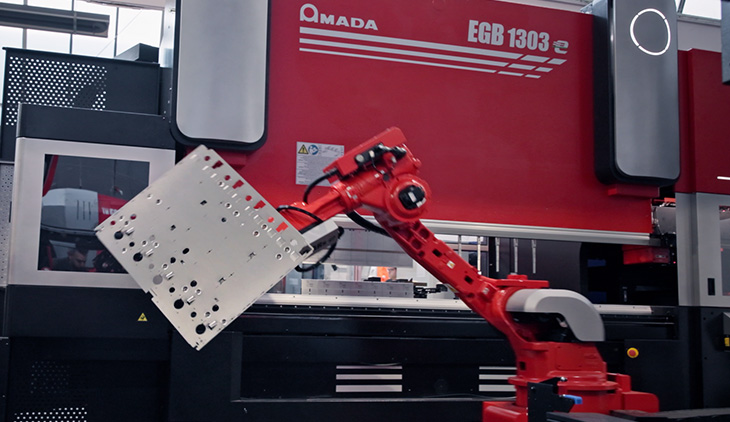
Automation is no longer a topic of the future in sheet metal processing. Punching, laser cutting, press braking: In most core processes, the transition from manually operated machines to fully automated manufacturing cells has already been completed. However, the pace of development varies from place to place, and not every solution is cost-effective for every company. What is technically possible today, where the economic limits lie, and what this transformation means for people working in manufacturing are questions the industry is currently actively addressing.
BVS Blechtechnik is already deeply immersed in this transformation. The company operates automated manufacturing cells in several core processes and has many years of experience in the cost-effective implementation of automation.
Learn more about automation in sheet metal fabrication.
Laser Cutting and Punching: The State of Fully Automated Production
In laser cutting and punching, automation has reached a level that was hardly imaginable ten years ago. Modern systems feature automatic material feeding, integrated tool storage, and automatic part removal. So-called “parallel setup”—that is, preparing the next job while the machine is still processing the current one—enables virtually uninterrupted production with minimal staff involvement.
This requires reliable materials logistics. Automated high-bay warehouses—known in the industry as systems such as STOPA—ensure a continuous supply of raw materials to the production lines and remove finished parts without the need for human intervention. The result is production processes that can run completely unmanned for hours or even overnight.
Automated Bending: Robots Handle the Process
For a long time, automating the bending process was more difficult than automating the cutting process because handling sheet metal parts poses special challenges: The parts must be precisely positioned during bending and guided throughout the entire process. Modern robotic systems can now handle this reliably.
Press brakes with integrated tool magazines change tools automatically without operator intervention. Handling robots feed parts in and out fully automatically. Programming is primarily done offline: The motion program is created on a computer and transferred to the machine. With newer generations of robots, manual retraining during the initial setup is rarely necessary. BVS Blechtechnik operates five automated press brakes that set themselves up independently and, in combination with connected handling robots, produce fully automatically.
Learn more about automated bending in sheet metal fabrication.
Seamless Data Flows as the Foundation of Automated Manufacturing
In practice, it’s clear that automation is only as robust as the data flows that control it. A CNC machine that doesn’t communicate with the ERP system and a robot that doesn’t receive up-to-date order data are automated, but not networked. The crucial step is end-to-end software integration, from the CAD model all the way to the machine.
The goal here is not a monolithic, all-encompassing system, but rather a chain of clearly defined interfaces: design data flows into production planning, from there into the machines’ programming software, and finally to the operator at the machine. Where this chain functions seamlessly, there are no information gaps that lead to errors, downtime, or setup problems.
Quality Assurance in Automated Operations
Who performs the checks when no one is at the machine? This question arises during every fully automated shift, and the answer depends on the process.
In laser cutting and punching, inspection takes place outside the machine—that is, after machining. Integrated measuring systems within the machine itself are not common in these processes. In press braking, on the other hand, angle measurement systems are integrated directly into the machines: They automatically measure the bending angle, detect deviations, and correct the process before the next part is produced. This allows systematic errors to be identified early, before they affect an entire batch.
A full quality control check of all dimensions is typically performed at the end of a shift or at the start of the next workday. Today, stable processes enable unmanned production phases lasting six to eight hours while maintaining consistent quality.
How the Shortage of Skilled Workers Is Changing Investments and Work Practices
One of the strongest drivers of automation in sheet metal processing is not simply increased efficiency, but the shortage of skilled workers. When positions remain unfilled, machines must fill the gap. Fully automated night shifts, unmanned weekend production, and self-set-up systems have become an operational necessity for many companies. For many companies, automation pays off primarily because it compensates for staffing shortages and ensures production capacity.
A simple illustration can show what this pressure means for people on the production floor. Just a few years ago, a skilled worker stood at a manual press brake, bending metal to the same angle day in and day out. Today, someone sits at a computer in an automated manufacturing cell, programming sequences, monitoring processes via digital systems, and intervening manually only when the system requires it. It’s the same profession, but a fundamentally different job. Repetitive manual labor has taken a back seat; what’s in demand now is software proficiency, an understanding of processes, and a willingness to continue learning.
For young professionals who have grown up using digital tools, this shift often comes naturally. For experienced professionals, the transition sometimes takes more time. People who have worked a certain way for years don’t switch tools overnight. This isn’t a weakness, but a real challenge that many companies must actively address.
Are you planning to implement automation, or would you like to know which solution is best for your components?
Where processes reach their technical and economic limits
When it comes to the core processes of punching, laser cutting, and press braking, there are hardly any situations today in which automation fails. The significantly greater challenges lie in the downstream processes. In riveting and the assembly of subassemblies, varying part geometries, fluctuating tolerances, and small batch sizes all come into play—a combination that makes full automation uneconomical in most cases.
Partial automation, in which robots or assistive systems take over individual repetitive steps, is often the more pragmatic approach in this context. The company has developed its own solution for sorting laser-cut parts: This was long considered one of the last major manual tasks in sheet metal fabrication, because the variety of parts and their irregular shapes posed significant challenges for robots. Only recently have industrially viable solutions become available that automate this step using AI and image processing.
What Really Matters When It Comes to Implementation
Automation in sheet metal processing is not an all-or-nothing proposition. The most effective solutions emerge when companies carefully analyze which processes benefit from full automation, where partial automation is sufficient, and where human judgment is irreplaceable. Today’s technological advancements make many things possible that were still uneconomical or technically unfeasible just a few years ago. Whether automation makes sense is not determined by the machine alone, but by the interplay of all processes. A realistic assessment is therefore crucial.
FAQ
Which sheet metal fabrication processes are best suited for automation?
Laser cutting, punching, and press braking are among the most highly automated core processes. Reproducible parts, reliable CNC controls, and automated part handling enable high efficiency. Things become more challenging when it comes to assembly and manual joining processes, as the variety of parts and small batch sizes limit automation.
What does "setup during main production time" mean, and why is it important?
The next order is prepared while the machine is still in production. Downtime is virtually eliminated. This increases capacity utilization and is a key prerequisite for cost-effective, unmanned operation.
Can a sheet metal processing machine produce overnight without an operator?
Yes, with stable processes, automated material supply, and integrated quality assurance. Unmanned production runs of six to eight hours are now a realistic possibility in sheet metal fabrication—provided that material logistics, process stability, and quality assurance are seamlessly integrated. The final quality inspection takes place during the next shift.
How is automation changing the requirements for skilled workers?
The focus is shifting from manual labor to programming, process monitoring, and digital systems. Technical aptitude and a willingness to learn are becoming more important. The work is becoming more challenging and diverse.
Is automation worth it even for small batch sizes?
To some extent. When bending, automatic tool changes enable short setup times even for small production runs. For complex individual parts or geometries that vary significantly, manual or semi-automated operations are often more practical.