Welding vs. riveting: Choosing the best method for stable connections
In modern sheet metal processing, welding and riveting are the two most important methods for permanently joining components and ensuring the stability and durability of your products. But when is thermal welding the better choice, and when is mechanical riveting the more economical and smarter solution?
This guide highlights the key differences. We show you the criteria for selecting the right connection technology to achieve optimum results in terms of load-bearing capacity, tightness and costs.
Introduction to joining techniques
In sheet metal processing and manufacturing, welding and riveting are the fundamental techniques for creating stable and durable products. Both processes have their justification, but they differ fundamentally in their application, their costs and their final properties. Choosing the right joining technique is crucial to the success, stability and cost-effectiveness of your project.
At BVS Blechtechnik, we offer both methods in the highest quality. We work with you to decide which method best suits your requirements.
Welding and riveting in direct comparison
Here you can see the most important differences between the two connection techniques:
Welding (thermal joining)
Welding is a thermal joining method in which two metal parts are fused together through intense heating. The result is a continuous, material-locking seam.
| Advantages | Disadvantages |
|---|---|
| Maximum tightness: Ideal for water-bearing, hygienic or pressure-tight elements (e.g. food industry, laboratory systems). | Heat input: Potentially leads to warping and makes reworking (planing, grinding) necessary. |
| High strength: Very high load-bearing capacity and durability of the connection. | Cost-intensive: Requires special equipment and expertise. |
| Smooth surface: Weld seams can be sanded clean (important for the appearance). | Not for all materials: More difficult when joining different materials. |
Riveting (mechanical joining)
Riveting is a mechanical connection in which a metal pin (rivet) is inserted through two or more parts and then permanently deformed to create a strong, inseparable connection.
| Advantages | Disadvantages |
|---|---|
| Low distortion: No or hardly any heat input, so less reworking is required. | Reduced impermeability: Overlaps or small gaps remain, which are problematic in hygienic areas. |
| Cost and time efficiency: Often significantly cheaper and quicker to implement. | Protrusion: There is a protrusion of the materials/rivet heads (can be a design problem). |
Decision matrix: When is which method the best choice?
The choice between welding and riveting depends on several criteria, which we clarify in detail with you as part of our production-oriented design consultation. We actively check whether cost-reducing alternatives such as switching to a riveted construction are possible without jeopardizing stability.
You can also get a detailed overview of the advantages and disadvantages of both methods in our video: “Welding vs. riveting” – When is which worthwhile?
Welding is the optimal choice when …
- … the component must be absolutely tight (food industry, water-bearing elements, microwave laboratory systems).
- … a smooth, invisible joint is required (aesthetic reasons, no protrusions permitted).
- … the static load is extremely high and a material-locking connection is required.
- … the sheet metal is particularly thin and automated laser welding is the faster and cleaner solution without reworking.
Rivets are the ideal choice when …
- … the requirements for dimensional accuracy are high and distortion due to heat must be avoided.
- … The focus is on costs and time (rivet constructions can be significantly cheaper as there is no need for reworking).
- … different materials have to be joined together (e.g. metal with seals, as with complex components that generate heat).
- … a visually appealing connection is required that is nevertheless stable (e.g. with our special semi-tubular rivets).
BVS expertise: special processes and automated quality
We not only support you in your decision, but also implement both techniques at the highest level.
Special riveting technology: The BVS-USP
We are one of the few companies to use semi-tubular rivets. This enables an extremely low installation height on the closing side and an attractive, small head on the visible side. These “designer rivets” are visually appealing and stable – a clear advantage over conventional, more bulky rivet connections
Welding process at BVS
We offer a wide range of welding processes, both manual and robotic, to guarantee the highest quality and repeatability:
- TIG welding (tungsten inert gas): A very clean and efficient method with high strength, ideal for demanding components.
- MIG/MAG welding: Automated for series and robust applications.
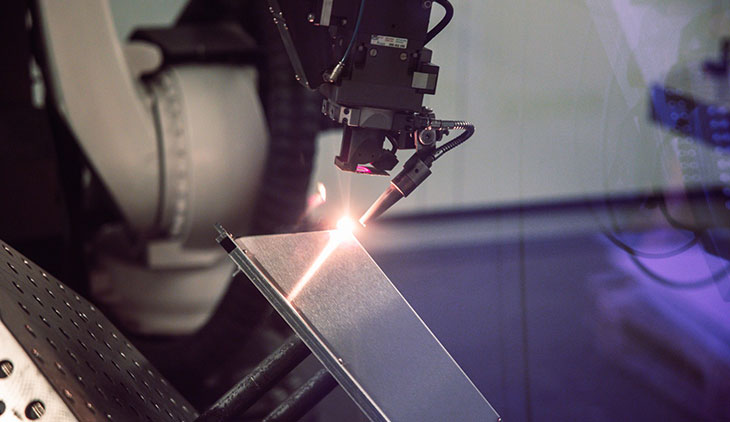
- Laser welding: This process is becoming increasingly important. It is automated and offers minimal heat input, often completely eliminating the need for rework – a major gain in efficiency and quality (e.g. for microwave laboratory equipment).
- Spot, projection and stud welding: For special requirements for connection points.
Certification and quality
Compliance with the highest quality standards is crucial in both processes. Our processes are documented and we meet the requirements of the most sensitive industries (e.g. medicine, electrical engineering), which is confirmed by our ISO certifications. Our Schwerin site is certified to the DIN EN ISO 3834-3 quality standard specifically for welding technology. This guarantees you process reliability and the highest quality in the production of welded joints.
Your project: In dialog to the best solution
Whether you opt for a converted rivet design, which is significantly cheaper and has less distortion, or for a tight weld seam in food technology – we will find the best process through dialogue.
Our aim is to offer you cost-optimized, stable and on-time production.
Make an appointment for a consultation and let us define the perfect joining technology for your components together.
Frequently asked questions (FAQs) about welding vs. riveting
What is the best connection technology for my project?
There is no universally best connection technology. The optimum solution depends on your specific requirements:
Welding is ideal if you need watertight or heavy-duty, aesthetically smooth welded joints, as the parts are joined with a material bond.
Riveting is better if you want low material distortion, need to save costs or join different materials.
How do I choose the right connection technology?
The choice is based on criteria such as:
- Static requirements and loads: How much force must the connection withstand?
- Material: Can the materials be welded at all (or is riveting easier)?
- Tightness: Does the connection have to be liquid-tight or gas-tight?
- Optics: Should the joints be visible (rivets) or ground smooth (welding)?
- Costs and assembly: Rivet assembly is often faster and cheaper than welding.
At BVS, we provide comprehensive advice to help you make the most economical and stable choice.
What are the advantages of welding and riveting?
Advantages of welding: Highest strength, absolute tightness, clean appearance, no protrusions.
Advantages of riveting: Less heat distortion, often cheaper, good suitability for joining different materials.
Rivetingand welding therefore both have their justification.
What are the safety regulations and quality standards for welding and riveting?
Strict safety and quality standards apply to welding and riveting:
- Quality: Compliance with standards such as ISO 9001 ensures process quality. Special industries (e.g. medical technology) often require additional certifications.
- Safety: Welding requires special protective measures against heat and welding fumes. When riveting, the primary concern is protection against mechanical hazards and the correct execution of the joining process.